Discriminatory Design in Education

What is Discriminatory Design?

Discriminatory design refers to the idea that there are some areas, laws, monuments/gardens/ landscapes that are either put in place specifically to prevent certain groups from using it or from doing certain things or sometimes inconsiderate of people who cannot benefit from these things. It might not be obvious at first that it is discriminatory design but sometimes its the things you look at and wonder “Why did they make this? How do we even use it now?” For example, benches with armrests in the middle were made to prevent homeless people from sleeping there. When that didn’t work they took it up a notch and made standing/leaning benches still with the armrests/separators or benches with spikes that go down when you pay to sit. There are also a lot of green areas and college campuses that are designed to look all fancy and decorated but are actually designed that way to stop people from exercising their First Amendment Rights. Another one that people tend to ignore is the lack of translation in important things like street signs and restaurant menus. In other countries they actually do have menus in multiple languages. Here we don’t because the “ideal language everyone should be speaking” is English.

What Might Discriminatory Design Look Like in the Classroom?

In the classroom, you might have students that speak different languages or have different learning needs or maybe even physical differences. It is important to design your lesson and your classroom to be inclusive of all identities. Otherwise, you will have discriminatory design in your classroom. For emergent bilinguals, this might look like not having translated text books, or even not teaching about other languages. For students with disabilities this might look like not having enough time to complete their work or not having the space for wheelchairs to be able to move. For students of color, this can look like only telling them the negative history about their culture/background instead of positive history. These discriminations will not be obvious to the typical person’s eye because they are not against them. But they are obvious to the people that are being discriminated against.

Think about it this way: Discriminatory design of education is the exact opposite of TRUDL

There are Ways to Prevent This in YOUR Classroom

Let’s be so honest and realistic: there are discriminations within the system itself that cannot just be changed that will always affect someone. However, there are things you can do to prevent discriminatory design in YOUR classroom. The first being follow TRUDL (your new best friend). Ensure that your instruction, the work, the classroom, is accessible to every student in your class. This will change every year, even throughout the year depending on your students. They could be big changes or small changes. You will know what you have to account for when you get to know from your students. When you become a teacher, you have to be willing to teach your students and learn from them as well. You have as much to learn from them as they have to learn from you. Whether that be about themselves and how they learn best, the holidays and traditions they celebrate, or any other knowledge on the content you’re teaching.

In my future classroom, I plan to ask my younger students questions like “Does anyone speak any other languages at home?” and “Who celebrates (upcoming holiday)?” Notice that these questions are aimed at whole class and don’t say “Do you…” as that insinuates assumption. I would then give students the opportunity to teach the class about their experiences and knowledge on the subject which shows students that I value their experiences and identities. As for students with disabilities, I would ensure that they are also able to learn about their peers’ experiences however I need to for that student and encourage them to speak about their own as well because students with disabilities celebrate holidays and speak other languages as well.

For older students, I would probably create a survey that students can take online asking questions about themselves, their learning needs/styles, languages they speak, and most importantly what they want to learn about. I want my students to value their education and by finding out and teaching what they want to learn about in ways that are beneficial and accessible to them, students feel respected and therefore respect what you have to teach them.

In both cases I would continue to try and teach my class at least a little bit about every type of identity out there because when there is respect and awareness for their identities, they continue to respect others. Students learn best when they see themselves in their learning and the only way they will do so is if you learn from them and continue to include what you learned in your lessons.
Designing with TRUDL in Mind

In my previous two posts, I discussed translanguaging and why it is important to create space and opportunities for it in the classroom as well as intersectionality and UDL. UDL is when you design your lesson keeping everyone’s needs, backgrounds, and otherwise identities in mind. Now I want to talk about what the theories look like together: Translanguaging + Universal Design for Learning (TRUDL)

What is TRUDL?

TRUDL is when we meet the the learning and language needs of students as well as acknowledging their learning needs, backgrounds, abilities, and otherwise identities but make it available to everyone. I would like to preface that students with language differences do not necessarily have learning differences and should not be treated as if they do. On the other hand, if it is specified that a student has both language and learning differences then both need to be accommodated This doesn’t have to be as simple as translating a text to another language or as complicated as making 10 different types of worksheets. TRUDL allows you to be creative in your design as you have to ensure everyone can benefit from it in some way.

Idea for TRUDL Aligned Lesson

In my future classroom, this is a lesson that I would design following TRUDL:

Lesson Objective: Students will analyze a picture book through different points of view

Materials: Unspoken: A Story From The Underground Railroad by Henry Cole, paper and online T-Chart

Procedure: Teacher will open the book. Since there are no words, the teacher will ask students what they see and feel when looking at the illustrations. During discussion students can turn and talk to share their thoughts and the teacher will choose a few students to share out. Students can share in the language they are comfortable in. After analyzing the story, the teacher will ask students what they would do in the POV of the girl and the POV of the enslaved person. Students will fill out a T-Chart answering these prompts with either a written response (in a language they’re comfortable writing in– you can always translate their work) or a drawn response (especially appropriate because this is a picture book). The T-Chart can also be made available for students to fill out online. Students can share with their partners, their table groups, or the class.

This lesson teaches point of view through Black history, namely slavery, by having the students analyze and discuss how they feel and how they think the characters feel. This lesson also uses a picture book, so there are no words to push students to think a certain way or to confuse students with language or learning differences which allows for full critical analysis from all kinds of learners. Since art is subjective, students will have different thoughts and feelings about them and these will grow and develop as they grow and learn more about the subject making this lesson appropriate for a wide age range including elementary, middle, and high school. The response is inclusive as students are responding to a prompt based on their own opinions and they have options for how they want to fill out the T-Chart including physical paper options and online options.

Why TRUDL?

TRUDL is so important in any classroom, but especially in those where students speak different languages, have different learning needs, backgrounds and identities. TRUDL not only ensures that all students are acknowledged and have access to the education, but also teaches students about other identities and languages and to accept these as different, NOT less than.

Teaching with Intersectionality in Mind

Especially in a diverse city like NYC, we see all different types of people from different places, with different pronouns, living situations, everything. No two people are the same. What a lot of people don’t recognize is that these identities change and develop over time. Especially in the preteen-young adult years when we’re experimenting, finishing/starting school, careers, families, finding ourselves, going through highs and lows. So how do we teach students going through these changes and developments? Well first let’s talk about intersectionality.

What is Intersectionality?

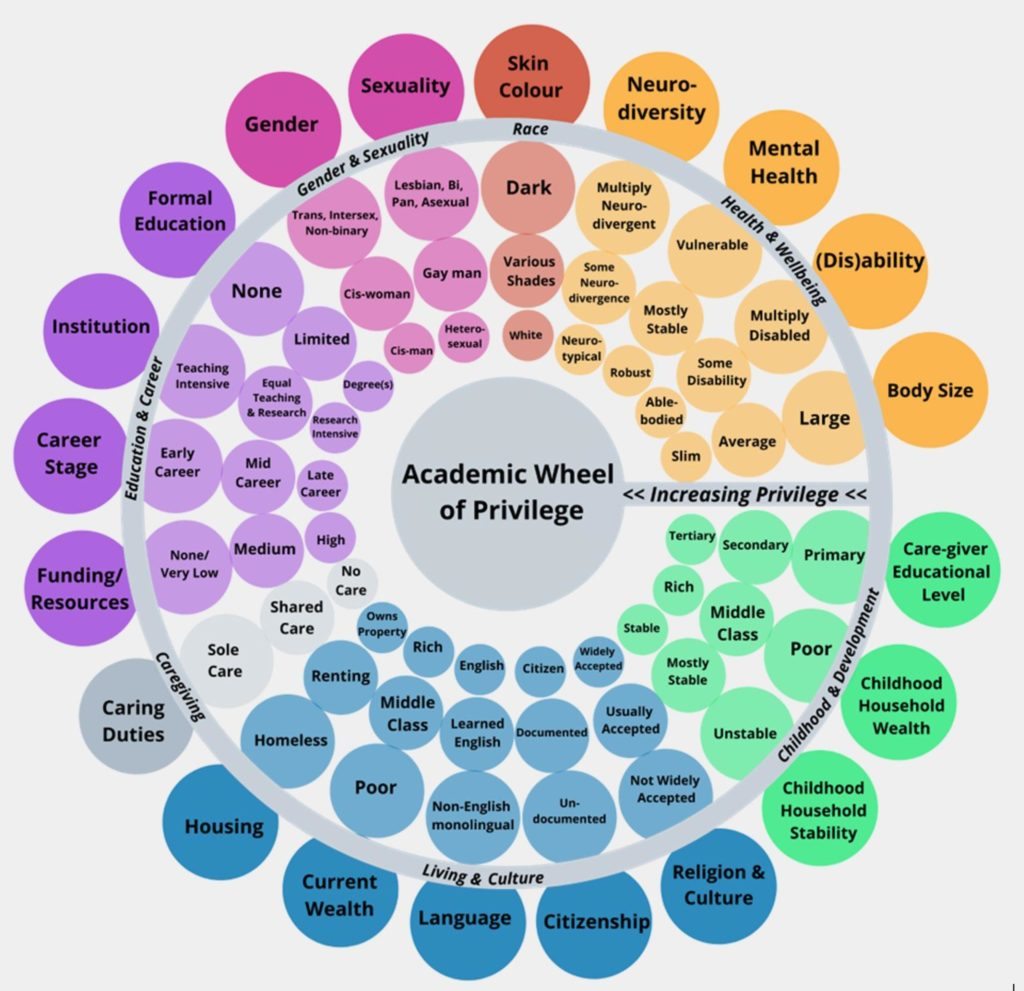
The image above encapsulates numerous types of identities and as you can see, they range from least to most privileged as you go farther in. Intersectionality is the identification with more than one of these identities. For one very simple example, a dark skinned woman who speaks Spanish is an intersectional identity. A lot of identities are born into and cannot be changed like your skin color, neurodiversity, ethnicity, and disability. Some are technically born into but not realized until later years like your gender identity and sexual preference. Some change depending on your actions like housing, language, education level, wealth etc. These are just a few examples. But every person identifies with a different combination of these identities and that combination changes over time.

How Do We Teach Intersectional Identities?

When teaching students, we must at the very least attempt to keep all their identities in mind. You have to consider what is accessible to them both when designing your lesson and thinking beyond your lesson when students leave the classroom. We also can’t assume that a student knows or doesn’t know something, or can or can’t do something based on their identity. One surefire way to do that is by following the Universal Design for Learning (UDL) when planning lessons. UDL ensures that everyone’s needs and identities are acknowledged but does not single anyone out. Because it is universal, everyone receives the differentiation included in the lesson.

This sounds very broad and complicated. Here are some simple strategies to include students identities into the classroom and into the lesson:

  • Teach students about history that includes their identities, NOT just during their respective months– We have months and days celebrating different types of identities such as Black History Month, Pride Month, Autism Acceptance Month, Women’s Day but history did not just happen within these months and should not only be taught within these months. Only teaching about certain history in these months sends a message that students who identify with these identities are only important during these times
  • When designing your lesson, differentiate for different learning needs in the classroom– this is crucial in every lesson and situation anyway because all students need to be engaged and included. But including students with different learning needs creates an inviting learning environment. Don’t just make specific worksheets for specific students. Make these differentiations available to everyone as an option. It isn’t always obvious who might benefit and some students who you don’t expect might choose these differentiated options.
  • Design an “I Am” project where students identify themselves– This gives students the opportunity to creatively tell us who they are through various methods such as drawing, slide presentations, coding projects, writing, etc. This project also gives teachers a way to learn about their students who might be uncomfortable with ice breakers and telling everyone who they are.
  • When assigning projects, have students work on them in class to ensure full engagement, accessibility, and success– some students aren’t able to complete work at home for various reasons such as other responsibility, lack of space, and lack of materials/resources to name a few. One way to ensure that students will be able to complete their projects is by giving them the time, space, and tools to do so. This is also ideal for group projects but works for individual projects as well
  • Be accurate to history, not just the curriculum– the curriculum in some states pushes certain versions of history or deliberately make certain groups look better or worse and these ideas are then instilled into these students minds. Teachers need to be mindful and accurate to the history that actually happened because students deserve to know where their identities came from and why they are important

In classrooms where every student identifies with different combinations of identities, the theory of intersectionality is crucial to go by as it serves as a reminder that all students have different needs, types and levels of knowledge, and backgrounds that need to be acknowledged. It also reminds us that no two people think the same but that doesn’t invalidate anyone’s thoughts. When teaching, we have to try ensure our instruction and the content is beneficial to every kind of identity.

Teaching with Translanguaging in Mind

What is Translanguaging?

Translanguaging is the ability to use your entire linguistic repertoire to learn and communicate. This could look like communicating in multiple languages, or if someone is unable to use speech it might look like using multiple ways to communicate like Augmentative and Alternate Communication (AAC), Picture Exchange Communication System (PECS), sign language, etc. When a person is able to translanguage, meaning they are given the opportunity to, they are able to communicate for themselves, not just for the recipient’s eyes and ears, and they don’t have to worry about whether or not everyone understands them.

Translanguaging is especially important in the classroom for emergent bilingual students as it helps them to learn and truly benefit from instruction. Translanguaging in the classroom can look different depending on the students and their learning needs. Some students might understand English but feel more comfortable responding in their native language. Some students can speak in a language but not read or write in it and vice versa. Regardless, in order to teach the student, you must take their linguistic needs and abilities into account and cater to them as you would with any student with needs other than typical.

How Can We Design with Translanguaging in Mind?

There are numerous ways to reach our emergent bilingual student and include them and their language into their education. It isn’t going to look the same for every class as different students have different language needs. But you must always design your lesson with their language needs in mind. Here are some ways you can do that:

  • Incorporate a translating device– This works when the teacher doesn’t share a common language with their student. They can teach into the translating device and have the translated audio played for the student. In turn, the student can speak into the translating device (This is something I’ve seen firsthand for the one student who didn’t share a common language with the rest of the class).
  • Translate readings/texts into their language– This is more for students who know how to read, regardless of the language. If the point of the lesson is beyond reading in English, it can and should be given in other languages as well. The point of education is for the student to benefit from it.
  • Include the students by asking them about their language– Some stories and sayings are universal or with minor differences in every language. Ask students how a story goes in their country or how a saying goes in their language. Listen to how similar and different they are
  • Allow students to access their full linguistic repertoire– If you are multilingual, you know sometimes you forget a word in one language and want to say it in another language. Give students the opportunity to communicate in every language they know. The point of instruction is for the student to learn and sometimes discussing what they learned helps the student. If they can’t get their full thought out in English they should be able to say it in their language, otherwise they are not getting the most out of their learning.
  • Have students teach the rest of the class some words in their language– This can work for students who are new to the country and the language, multilingual students in general, and non-verbal students who use an alternative form of communication such as AAC. If they’re comfortable having the student teach the class a generally used word or a phrase like “Hello, how are you?” or how they use their device to communicate can make the student feel valued as it isn’t just them learning the common language or using the AAC. Now the rest of the class is learning their language or about their AAC, which doesn’t necessarily level the playing field, but now the student might be greeted by their peers in their own language or is not being singled out or made fun of for using AAC to communicate which already makes the environment much more inviting.

Sometimes it isn’t only about teaching, it is also about generally making the student feel included and that the whole student (their knowledge, feelings, language, culture) is welcomed. There isn’t a specific recipe for these strategies. These are suggestions and ideas to teach and include students who have different language needs and are very customizable depending on the students.

Who are Emergent Bilingual People?

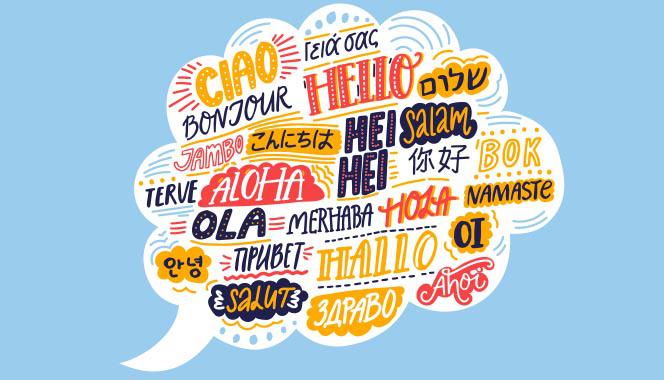
How to Say Hello in 10 Different Languages?

Terminology

You might have heard the term English as a Second Language (ESL), or today, English Language Learner (ELL), especially if you are or were one of these students. Let me introduce to you a new term for people who are learning a new language (that may or may not be English): Emergent bilingual. This term encapsulates anyone who is learning to be proficient in a language other than what they speak at home with their families. Here, that might be someone learning English, or in my case, relearning their native language. In another country, that might be someone whose family moved from another country to that one and they are acquiring the language of that country. These are just a few examples of the many types of emergent bilinguals there are

Don’t Assume

Usually the first group of people that comes to peoples’ minds is people of Hispanic/Latinx origins. But they are not the only emergent bilinguals that exist here. Emergent bilinguals exist all over the world. In the United States, as matter of fact, in NYC alone we have emergent bilinguals from all over the world speaking different languages, variations, and dialects that don’t always quite understand each other. You might see someone in the street and think they speak “perfect” English, turns out they actually don’t speak a lick of it. On the flip side, you might see someone in the street and think they can’t understand you, turns out they understood every word and they actually only speak English. I for one was an emergent bilingual and I was born here. And here’s the kicker: I’m white and I speak English without an accent. You can’t assume that someone understands a language or doesn’t based on how they look or even how they speak.

New York city map highlighting the top immigrant group by neighborhood.
https://www.visualcapitalist.com/new-yorks-largest-immigrant-groups-by-neighborhood/

My Own Experience as an Emergent Bilingual

My family is Ukrainian and I grew up speaking Russian because when they left Ukraine the USSR had just disbanded the year prior. I went to a Russian day care where everyone else also spoke Russian and watched Russian cartoons. My parents spoke a little bit of English and with a heavy accent and my grandma only speaks Russian to this day. The only people in my family that were really speaking English were my cousin and my sister who are 9-10 years older than me. I started learning English little by little watching English shows like the Big Comfy Couch, Blues Clues, Sesame Street, etc.

Then I started Kindergarten in an American public school. I thought was able to understand English enough that I could learn and just let my accent ride out, overly confident. From my mom’s POV I spoke very little English and I was very shy to speak to anyone that didn’t speak Russian. We had a big laugh about this. I asked her if they asked for consent or let her know that they’re putting me in ESL or if it was just obvious to her that that would happen and she said they didn’t let her know but it was obvious that I would be getting some kind of help. My sister actually started in a Russian private school near me and then transferred to a public school like a year or two later. Apparently, they were teaching her English though and she spoke English just fine in the public school

All this to say that emergent bilinguals look different, come from different places, different family dynamics, and learn and speak different languages. Spanish and English are not the only languages we hear, especially in NYC.

A Little About Myself

My name is Carina, or to my future students, Ms. Carina. I am currently a student at Brooklyn College studying to be a teacher for both general and special education. It’s been a passion of mine since I first saw that giant pointer finger, manipulatives that I could never use, and the smoothest, velvetiest, markers I’ve ever had the pleasure of using: the Sharpie Chart Marker. When I was little I used to dream about having all that in my classroom and actually using it with my students. I’m so proud to say I’m actively making that dream come true.

As soon as I was legally able to work, I started working at a summer camp that I went to in my childhood and eventually their after school program. I loved it but by senior year when I had to choose a major, education was the last thing I wanted to do because it was the only thing I knew and I had to know if I wanted to do something else.  I tried marketing for one semester and quit to go to teaching. I started when my school had just opened the Special Ed major so my cohort is kinda who they’re testing the major on? So that’s really cool (to me at least). But it’s also cool to be learning about how to work with so many different kinds of people at different ages and learning levels, not just typical young kids.

When I was working at that after school, I met this really young girl with autism and absolutely adored her. She wasn’t my student but I would see her around. She was the sweetest thing and for years after we first met she would still run up to me, “Carinaaaaaa!!!!” so excited to see me. She’s the person that got me interested in special education for the first time ever when I was 16 years old.

A lot of people hear me say I plan to teach special education and respond with comments like “I could never”, “You’re brave for that”, “You must have a lot of patience”. But it really isn’t about that. Or all about that I should say. I could say the same thing about accounting, business, trade work but no one ever comments these things when they think about these careers. Even a lot of current teachers make these kinds of comments. It’s sad to see teachers ignoring some of their students because they don’t know how to deal with their disabilities and I aim to be the teacher who is there for everyone. Not because I’m brave or have patience, but because I feel that all students deserve a teacher that actually wants to teach them. And I feel that all teachers deserve to be called more than just teachers